Target Date Funds (TDFs)
Target Date Funds (TDFs) are designed as a “one-stop-shop” for your retirement assets. By investing in a TDF, you choose a fund whose number corresponds to your expected retirement year. This fund has a predefined asset allocation that adjusts automatically as you approach retirement. However, selecting a fund should not be based solely on your time horizon. Your investment decisions should also consider your financial goals and risk tolerance. Target Date Funds typically assume that your primary goal is retirement, which may not be suitable if you have other financial objectives. Moreover, these funds do not account for individual risk tolerance.
TDFs simplify investing but are subject to real market risk, including significant losses during bear markets. While they tend to lose less during bear markets, they also gain less during bull markets, making them less volatile and advertised as less risky.
TDFs allocate proportions of each equity fund based on their market value. These equity funds are diversified geographically across the developed world on a value-weighted basis. This geographic diversification results in an underweighting of global technology compared to holding only U.S. equity funds.
The Department of Labor’s report Characteristics and Performance of Target Date Funds in the United States found:
There are large differences among TDFs, even among TDFs with the same target year. Adjusted for risk, we find large differences in rates of return, which are only partially explained by funds’ expense ratios. Also, a fund’s target year is not necessarily indicative of the extent to which it tolerates risk. For example, the returns of some 2030 funds were more volatile than those of some 2020 funds.
The spread is not small: the gap in alpha between the 10th- and 90th-percentile funds averaged 3.7 percentage points a year over 2000–2016.
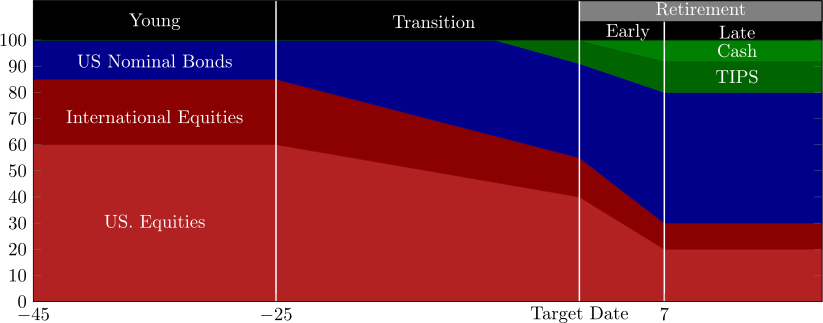
TDFs with the same target year may have different glide paths, so research your fund’s glide path. E.g., for Vanguard, the glide path doesn’t level off until target year plus 7. T.RowePrice funds can have 97% in TDFs 25+ years from retirement, and 60% in TDFs 5 years from retirement.
This is also the problem with the “take 100/110/120 minus your age to determine your bond allocation” statements — they only look at your age, and ignore everything else (including the risk of bonds).
- TDFs are a family of funds with different target dates corresponding to your approximate retirement year.
- These funds are the default 401(k) investment when you don’t make an explicit choice, and that is a regulatory artifact, not an endorsement: the Department of Labor designated target date funds a qualified default investment alternative (QDIA) in 29 CFR § 2550.404c-5, which shields the plan fiduciary from liability for the outcome. The rule protects your employer from liability instead of protecting your retirement balance.
- Your contribution rate is a separate default from the investment, and it is now partly mandated. Under IRC §414A, “Requirements related to automatic enrollment”, added by § 101 of the SECURE 2.0 Act of 2022 and effective for plan years beginning after 31 December 2024, plans established after 29 December 2022 must automatically enroll you at between 3% and 10% of pay, escalating one point per year to at least 10% but no more than 15%. Long-standing plans are grandfathered and commonly default at 3% to 6%. Whatever the default is, plan sponsors chose it for compliance optics, not your retirement adequacy — raise it yourself.
- TDFs are funds of index funds. A typical far-dated vintage holds four: total US stock and total ex-US stock (roughly 60/40 of the equity sleeve), total US bond and total ex-US bond (roughly 70/30 of the bond sleeve). Near-dated vintages add a short-term TIPS fund, so do not assume the four-fund structure holds across the family.
- The stock/bond ratio in a TDF changes according to its glide path, which automatically adjusts the asset allocation based on how close you are to retirement.
- Each financial institution uses a different glide path. Review the prospectus to understand the glide path for your TDF and determine your current position along this path.
“To” versus “through”. This is the term to search for in your prospectus. A to-retirement glide path reaches its final, most conservative allocation at the target year and stops. A through-retirement path keeps de-risking for years afterward — Vanguard’s levels off at target plus seven. Two funds with the same year on the label can therefore hold materially different equity at the moment you retire, which is exactly the moment sequence-of-returns risk is highest (section “The Default Sequence Is Wrong”). Neither design is wrong; holding one while believing it is the other is.
If your fund has no ticker, it is a collective investment trust. Most target-date assets in large 401(k) plans now sit in collective investment trusts (CITs) instead of mutual funds. A CIT is a bank-maintained commingled vehicle regulated under banking law and ERISA instead of the Investment Company Act of 1940. It has no ticker, no publicly filed prospectus, and no Morningstar page, so the research routine below will simply fail for it. CITs are usually cheaper than the equivalent mutual fund, which is why plans use them — but you must get the fact sheet and glide path from the plan administrator, and you cannot hold the same vehicle outside the plan.
| Target Year | Vanguard | Charles Schwab | Fidelity | Nuveen |
| 2070 | VSVNX | - | - | - |
| 2065 | VLXVX | SWYOX | FFSFX, FFBSX, FFIJX | TFIHX |
| 2060 | VTTSX | SWPRX | FDKVX, FHANX, FDKLX | TVIHX |
| 2055 | VFFVX | SWORX | FDEEX, FHAOX, FDEWX | TTIHX |
| 2050 | VFIFX | SWNRX | FFFHX, FHAPX, FIPFX | TLLHX |
| 2045 | VTIVX | SWMRX | FFFGX, FHAQX, FIOFX | TLMHX |
While less customized, a target date fund represents a superior alternative to non-participation. If the choice is between a target date fund and remaining entirely in cash, electing the fund is mathematically preferable. FINRA’s Fund Analyzer lists the available TDFs and compares their fees side by side. Despite a lack of flexibility, target date funds are simple to implement, typically have low fees, and automatically reallocate as you age.
You must thoroughly understand the composition and glidepath of any target date fund in your portfolio. Typically, equity exposure begins to decrease 25 years prior to the target date and stabilizes seven years post-retirement (see Figure 11.6). Upon reaching the target date, the fund transitions into a retirement income strategy, modifying its asset mix. Review the fund prospectus to verify these parameters.
Buy the underlying index funds separately if you prefer to manage your own glidepath.
Never hold a target date fund in a taxable account. In a 401(k) or IRA the wrapper is fine. In taxable it is a structural mistake, for three reasons that compound.
First, you cannot control distributions. A TDF is a fund of funds that rebalances internally along its glide path, selling appreciated equity to buy bonds — inside the fund, on the fund’s schedule, generating capital gains distributed to you whether or not you sold anything. Second, you cannot tax-loss harvest. A 2008-style drawdown hands the direct owner of the component funds a harvest of losses to bank against future gains (section “Tax-loss harvesting”); the TDF holder sees one blended NAV and can harvest only if the whole thing is underwater. Third, you cannot place assets — the bond sleeve throwing ordinary income sits in the same wrapper as the equity sleeve throwing qualified dividends, which is the exact opposite of section “Assigning Assets into Tax Buckets”.
The first risk is not hypothetical, and the canonical case is instructive because the sponsor was the low-cost, investor-aligned one. In December 2020 Vanguard cut the minimum investment for its institutional Target Retirement funds from $100 million to $5 million. Retirement plans promptly migrated out of the retail share class, the funds had to sell appreciated holdings to meet those redemptions, and the resulting capital gains — in some vintages exceeding 10% of NAV — were distributed to the retail investors who had stayed put. Anyone holding in a 401(k) noticed nothing. Anyone holding in a taxable account received a tax bill for a transaction they had no part in and no warning of. The SEC charged Vanguard over the disclosures and it paid $106.41 million to settle in January 2025.
The lesson generalizes past Vanguard: in a pooled fund, other shareholders’ redemptions can generate your tax bill. Own the components directly in taxable and run the glide path yourself — it is four funds and one rebalance a year.
One development may narrow this in future. Since the SEC began approving ETF share classes of existing mutual funds in late 2025 (section “The ETF Share Class, and Why the Mutual-Fund Verdict Is Now Conditional”), a fund with an ETF class can purge low-basis lots through in-kind redemptions to the benefit of all share classes, including the mutual fund one. If your target-date provider adds such a class, the distribution problem above shrinks substantially. Check before you restructure a taxable position — and note that the other two objections, no loss harvesting and no asset location, survive regardless.