Loan Amortization (Annuities)
An annuity is a series of equal payments made at equal intervals — and before the word conjures an insurance product, notice that you almost certainly hold one already: a mortgage is an annuity you pay, a pension is an annuity you receive, and regular deposits into a savings account are an annuity you build. Loan amortization — paying off debt through regular payments that cover both interest and principal until the balance hits zero — is the same mathematics run from the lender’s side, which is why one set of formulas below prices all of it.

- — Initial loan size (present value () of loan)
- — Interest rate described as an annual number (%, 0-1), e.g., 0.06 for 6%
- — — Interest rate per payment(month) (%, 0-1), e.g., 0.005 for 6%/12=0.5%
- — Monthly payment
- — Number of payments (months), e.g., 360 for 30 years loan
- — Future value
The future value of the loan at time is:
The future value of monthly payments is:
The bracket is not magic. The first payment compounds for periods, the second for , the last not at all, so the total is — a geometric series, whose closed-form sum is the bracketed factor.
Monthly payment is derived from the requirement that at the end of the term, the should be equal to :
If you want to find the number of periods in which a given payment will pay off the loan, you can solve for :
Where the logarithms came from: rearranging the payment formula isolates , and taking the log of both sides is what pulls down out of the exponent — that is the only job logarithms do in this book. If you would rather skip the algebra, the spreadsheet function NPER(rate, -payment, principal) computes the same thing.
Two things about this formula are worth more than the algebra. First, run a number: on the $500,000, 6% mortgage worked below, the scheduled $2,997.75 payment takes 360 months by construction, but raise it to $3,500 and months — an extra $502 a month retires the loan nine years early. Second, look at what happens when , here $2,500: the argument of the logarithm hits zero or goes negative and ceases to exist. That is not the formula breaking; it is the formula telling you that a payment at or below the periodic interest never touches principal, so the loan never ends. Credit-card minimum payments sit just above this line — pay only the minimum and the formula answers in decades.
The difference between and gives the remaining balance of the loan at the -th period:
In Figure 2.3 you can see how all these values change with time. approaches at the end of the loan term, and at , =0.
The formula you will use most. Rearranging the payment equation gives the present value of an annuity — what a stream of payments of is worth today at rate :
where is shorthand for — the same discounting divisor as before, written as a negative power.
This is the workhorse of personal finance. It prices a pension buyout against a lump sum, tells you what a rental income stream is worth, values the payments in a structured settlement, and answers “how much house can I afford” by running the mortgage formula backwards from a payment you can sustain. One number to see it work: a pension offering $30,000 a year for 25 years against a $350,000 buyout. At a 5% discount rate the stream is worth , and the buyout is offering you 83 cents on the dollar; at 8% the stream is worth about $320,200 and the buyout wins. The formula does not make the decision — it forces the decision to be about the discount rate, which is where it belongs.
Ordinary annuity versus annuity due. Everything above assumes payments arrive at the end of each period — an ordinary annuity, which is how mortgages, car loans, and bonds work. Rent, insurance premiums, leases, and most pension payouts arrive at the beginning of the period, making them an annuity due. Each payment then has one less period to be discounted, so:
At low monthly mortgage rates the gap is negligible. On an annual stream at 8% it is an 8% difference in value — large enough to decide a pension election. Check which one you are being quoted.
Worked example: a $500,000 mortgage. Thirty years at 6% nominal, so and :
Over the full term you pay — meaning $579,190 of interest, more than the house cost. That number is the true, total sticker price of a mortgage, and it is never the one on the disclosure you sign.
Now the part that surprises people. The balance after five years, from the remaining-balance formula above with :
You have paid $179,865 and retired $34,728 of principal. Just over 80 percent of five years of payments went to interest. This is not a scam; it is what amortization does — interest accrues on the outstanding balance, which is near its maximum early on. This creates two direct financial realities: early extra principal payments are enormously more effective than late ones, because every dollar applied in year one avoids thirty years of compounding interest. And if you expect to move within five to seven years, the interest you will pay dwarfs the principal you will build, which is the real math behind the rent-versus-buy decision (section “Rent vs Buy decision”).
APR is not the rate you pay. A loan quoted at 6% compounded monthly does not cost 6% a year. The annual percentage rate is a nominal convention — the periodic rate times the number of periods — while the effective annual rate is what actually compounds:
At 6% compounded monthly, . Compounded daily it is 6.18%. The gap widens fast at higher rates: a credit card at 24% APR compounded daily has an EAR of 27.1%. Always compare loans on EAR and deposits on APY (the same calculation, sold under a friendlier name) — and be aware that the disclosed APR on a mortgage also folds in points and closing costs, which makes it a better comparison figure than the note rate but still not the compounding rate.
Break-even thinking. One more named move belongs in the toolkit here, because every financing decision uses it: the break-even (payback) period is the upfront cost divided by the periodic saving. Refinancing with $12,000 of closing costs to save $500 a month breaks even in 24 months; mortgage points, a solar roof, and a warehouse-club membership all price the same way. The twist that does the real work: compare the payback against how long you will actually keep the loan, the roof, or the habit — not against the term printed on the paper. A refinance that pays for itself in year two is a loss if you sell in year one; the full treatment, including the term-reset trap, is in section “Cash-out Refinance”.
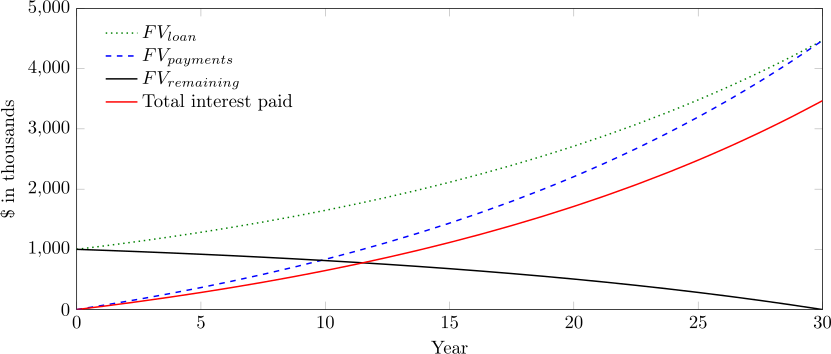
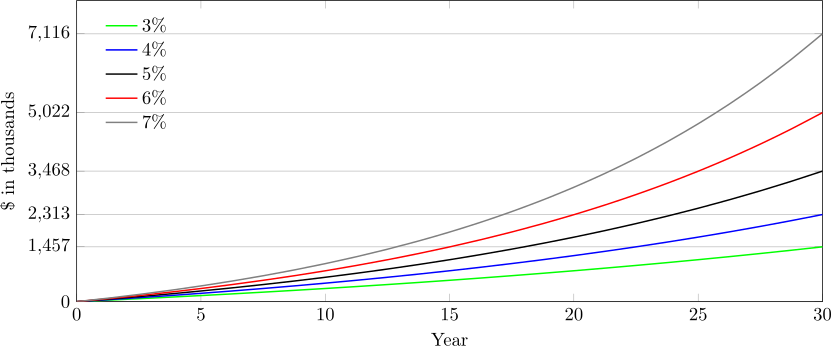
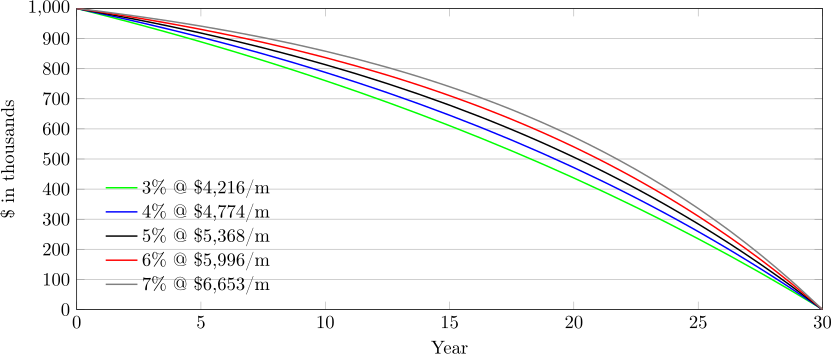
Figure 2.4 and Figure 2.5 show the interest rate’s impact on amortization. While the remaining balance evolves along similar-looking curves, the payments and total interest differ sharply: on the $500,000 thirty-year mortgage above, 5% versus 7% is $2,684 versus $3,327 a month — about $231,000 of additional interest over the term, from two points of rate. Rate shopping is the highest-paid hour of the entire transaction.