Human Capital: Skills, Education, Earnings Potential
A financial life runs in three stages — learning, earning, and enjoying. This book lives mostly in the second and third, work and then retirement, but the whole thing is set in motion by the first. What you learn early fixes the ceiling on everything that follows.
The order is not negotiable. Human capital comes first, and financial capital is what it leaves behind: a portfolio sits downstream of an income, and an income sits downstream of skill. Every later chapter — investing, tax, asset protection, estates — presumes you have already built something worth investing, sheltering, and handing on. None of that machinery runs until the earner exists.
Training — formal or picked up on the job — is what builds earning capacity over a lifetime, and the research leans hard on the point.5,6,7,8 Education is an investment in your own productivity, and the market prices it by how scarce and how useful the skills turn out to be.
- Human capital
-
is the present value of your future labor income over your remaining career.
- Financial capital
Human capital is intangible, but early on it runs the show; for a young professional, it is the only asset that matters. The Hamilton Project, a policy initiative within the Brookings Institution, put hard numbers on how wide the spread gets in its study “Career Earnings by College Major”:
Over the entire working life, the typical college graduate will earn $1.19 million in today’s dollars. This is more than twice as much as the lifetime earnings of a typical high school graduate ($580,000), and $335,000, or 39 percent, more than that of a typical associate’s degree graduate. What is less understood is that not all college degrees are the same. Earnings differ dramatically across majors—in starting salaries, wage growth over time, and ultimately lifetime earnings.
Read those figures as present values, not cumulative paychecks. The Hamilton Project discounts a lifetime of earnings back to today, which is why $1.19 million sits so far below the $2–3 million undiscounted totals quoted elsewhere. The discounted framing is the right one for a decision you are making now, and the reason it belongs in a chapter that starts with present value.
Working from more than 5.8 million graduates in the American Community Survey, a recent study9 computed the Internal Rate of Return (IRR) of a college degree by major — treating tuition and forgone wages as the investment and the lifetime earnings premium as the return — and found the better majors clearing what broad stock indices have historically returned, even after accounting for rising tuition. Engineering and computer science lead, above 13%. Business, health, and math and science land between 10% and 13%. Biology, agriculture, and the social sciences fall to roughly 8–9%, and education, humanities, and arts sit below 8%.
Two qualifications carry real weight: returns are markedly higher at the top of the earnings distribution within every major, so the median figure understates what a strong graduate captures and overstates what a weak one does — the degree is not a fixed-coupon instrument. And the premium has been drifting down over the study period, consistent with the flattening of college wage premiums since 2008. Read the ranking as a durable ordering; read the levels as a fading tailwind.
Human capital runs down as retirement approaches — each year worked is a year of future earnings removed from the discounted total. The peak is not quite day one, though. Early in a steep career the raises can outrun the shrinking horizon, so the present value of remaining earnings often keeps climbing into the late twenties or early thirties before it turns over. After that it falls monotonically, and the fall accelerates.
You cannot sell shares of your future labor the way you would sell a stock — but you can invest in it, and the investment pays whenever the discounted value of the raise it earns you clears the cost of tuition plus the wages you skipped to get it.
The U.S. Bureau of Labor Statistics publishes the “Occupational Outlook Handbook” — median pay, projected growth, and credential requirements for hundreds of careers. Read it cold, as a diagnostic, when you plan your next move or steer your kids toward theirs.
Early in your career you are accumulating: financial capital still negligible, human capital doing all the work. The job is to capture your labor premium and move it into assets that pay interest or throw off equity returns. Convert labor into investments early and compounding gets the one thing it actually needs, which is time.
Run your human capital like a business asset: keep learning, choose the work carefully, and look after your health, because a body that breaks down stops earning. Better skills command a better rate, and the raise widens the gap between what you make and what you spend — the surplus you get to save. Your total wealth is human plus financial capital, and the whole game is to move the first into the second before your ability to earn runs down.
Figure 1.1 illustrates how true total wealth might be distributed over your life cycle.
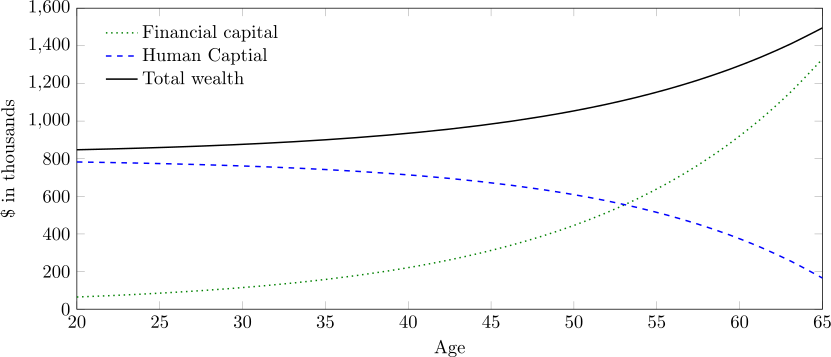
Your financial capital climbs over time on the back of steady saving and investment returns. Watch the shape of the curve, though: that exponential growth is compounding interest and regular contributions working together, and the longer you let it run, the steeper it gets.
Income is the direct readout of your human capital, which makes investing in it — yours and your children’s — the single biggest lever on lifetime wealth. Earn more and you can save more, invest more, and bankroll the occasional venture. The pattern shows up in the data: households aged 30–59 with higher lifetime incomes save a larger share of what they make, not merely a larger amount.10 Run the median American income through a savings-and-investment simulation and the result is sobering: the typical household has to do something extraordinary to reach a serious wealth milestone. Joining the top 1% means doing what the other 99% won’t.
While a high income alone won’t make you wealthy, nearly every wealthy individual has earned a high income at some point.
Suffering is also possible with enough mistakes made earlier
A deliberate commitment of present resources in expectation of larger future cash flows.
The present value (PV) of money reflects a basic truth: a dollar today is worth more than a dollar tomorrow. Future cash flows must be discounted by a chosen interest rate to reflect this time premium.
Property under your control carrying economic value, including cash, real estate, and securities.