Savings Rate For Retirement
From section “Estimating Retirement Needs” we take a baseline SWR of 4%, so you need to save 25 times the portion of retirement income that comes from your portfolio. Assume that in retirement you want to keep your current lifestyle but no longer have to save — roughly of your current income. The required savings rate is then:
|
| (2.5) |
To see where that comes from — and why your salary is not in it — substitute into the contribution formula above and divide both sides by income. Income cancels, which is why the required rate is the same percentage at every salary.
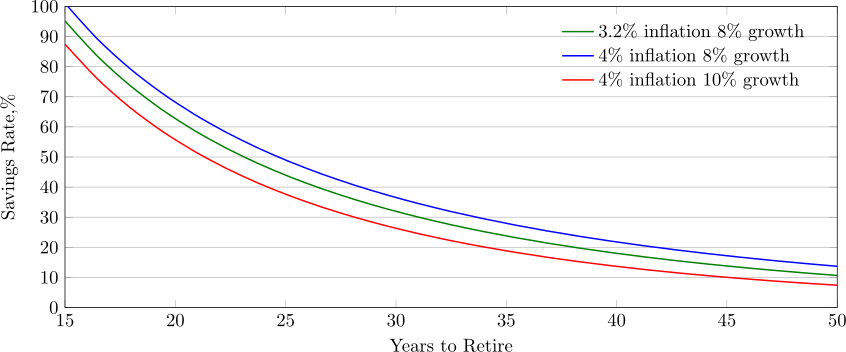
Figure 2.6 and Table 2.4 below demonstrate how the required savings rate shifts across scenarios, confirming that a baseline near 20% is the absolute minimum for typical accumulation timelines.
Note that it is linearly dependent on the fraction of your desired income to your current income.
| Inflation | Growth | Years to Retire | Savings Rate |
| 3.2% | 8% | 25 | 44% |
| 3.2% | 8% | 30 | 32% |
| 3.2% | 8% | 35 | 24% |
| 3.2% | 8% | 40 | 18% |
| 3.2% | 8% | 45 | 13% |
| 4% | 8% | 25 | 49% |
| 4% | 8% | 30 | 36% |
| 4% | 8% | 35 | 28% |
| 4% | 8% | 40 | 22% |
| 4% | 8% | 45 | 17% |
Making predictions about market growth is a thankless task. A prudent forward estimate is humbler than the historical record: roughly 7% nominal, a touch under what investors enjoyed in past decades. Nick Maggiulli, on Of Dollars and Data, ran simulations to estimate realistic portfolio growth, finding median real (inflation-adjusted) growth over ten years of about 1.35 for a global 80/20 portfolio and 1.5 for a US 80/20 portfolio. That is an annual real rate near 3–4%, the same story as the 7% nominal figure above once you strip out inflation.
Held at a constant 3.5% real, a lump sum multiplies as : about 1.4 over ten years, 2.0 over twenty, 2.8 over thirty, and 4.0 over forty. Do not confuse those with what a contribution stream does — money invested in year 18 has only two years to compound, so a dollar-cost-averaged portfolio grows far less per dollar contributed than a lump sum does. Both facts are true and they answer different questions: use the lump-sum multiple for money you already have, and the savings-rate formulas above for money you have yet to earn.
Better still, do not anchor on a historical multiple at all. Set your real return assumption from the current breakeven inflation rate and prevailing real yields (section “Forecasting: What the Market Already Thinks”), and revisit it annually. A forward-looking estimate that is occasionally wrong beats a backward-looking one that is systematically optimistic. And since a grounded estimate is lower than the one in the brochures, plan on some combination of saving more and working longer — one more argument for starting now.