Savings Rate Basics
Your personal savings rate is the ultimate lever in wealth building. No amount of portfolio optimization, market timing, or asset selection can compensate for a blank balance sheet.
The metric must capture both pre-tax and after-tax flows, and it must do so in a single ratio. Put every dollar saved over one consistent denominator:
Resist the temptation to compute two separate percentages — pre-tax savings over gross, after-tax savings over take-home — and add them. That is a common construction and it is arithmetically meaningless: the two fractions have different bases, so their sum measures nothing, and it systematically flatters you in proportion to your tax rate. On $200,000 gross with $60,000 of tax, $24,500 into the 401(k) and $20,000 into a brokerage account, the split calculation reports while the true rate is . Four points of imaginary progress, in the one number that actually determines the outcome.
If you prefer a denominator that excludes taxes — defensible, since tax is not discretionary — use take-home plus pre-tax savings on the bottom, so the numerator and denominator describe the same pool of money. What you must not do is mix the two.
Pre-tax contributions to a 401(k), Health Savings Account (HSA), and associated employer matching funds represent high-utility savings that grow tax-deferred or tax-free, magnifying the compounding effect for high earners.
For clarity, savings also include principal repayment on installment loans. Retiring debt has the exact same net-worth impact as acquiring a fixed-income asset: it eliminates a liability, removing a structural drag on future cash flows.
Standard retail advice suggests 10% or 15%. Treat 20% as the baseline floor, not the target. That rate delivers tangible structural benefits:
- Rapid Reserve Construction
-
Saving 20% of take-home pay allows you to quickly build an emergency buffer. If your essential survival expenses are 50% of income, you can secure a six-month reserve in under two years: months. The general relation is worth carrying: build time target months needs share savings rate, so it is the ratio of your needs share to your savings rate that governs — raise the rate to 40% and the same reserve takes 7.5 months, while a high earner whose needs are 30% of income builds it in 9 even at the 20% rate.
- Aggressive Liability Retirement
-
By routing your savings surplus beyond your basic living expenses, you can rapidly pay down outstanding debts using the avalanche method.
- Earning-Scale Proportionality
-
The 10% savings rate popularized by historical heuristics like The Richest Man In Babylon37 is functionally obsolete for anyone earning above the median. High income carries high tax brackets and high potential lifestyle creep. Unless you intend to take a massive drop in lifestyle in retirement, your savings rate must rise progressively with your salary.
- Strategic Options Funding
-
A 20% savings rate builds the liquid capital needed to max out individual retirement arrangementss (IRAs), fund 529 plans, build taxable brokerage sleeves, or fund an eventual business acquisition.
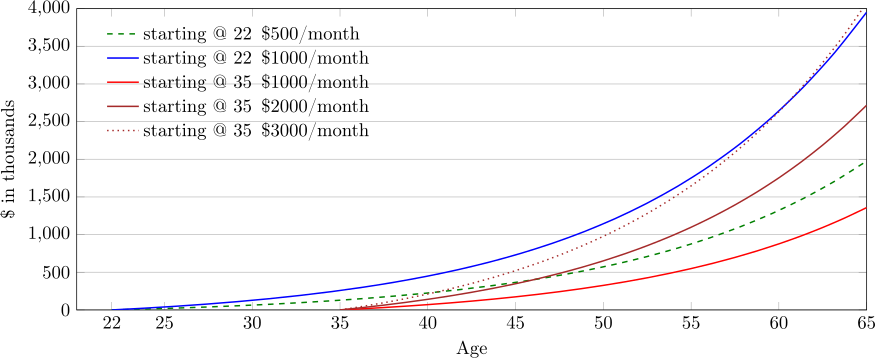
The primary career error is a low initial savings rate. Time is the multiplier; starting late forces you to commit exponentially more capital to achieve the same end state. As shown in Figure 1.2, starting your investment program at age 35 instead of 22 requires three times the monthly cash outlay to reach the same target, assuming a standard 8% nominal return.
The arithmetic of your savings rate is brutal:
- 50% Savings Rate
-
acts as a structural shield. You can make severe investment errors, suffer drawdowns, and still retire decades early because your cost of living is low and your cash accumulation is high.
- 5% Savings Rate
-
is a structural trap. You can execute a perfect investment strategy and still face destitution in old age because the absolute capital being compounded is negligible.
Maximizing the savings rate resolves the retirement timeline. At an 8% return, accumulating a target corpus takes 39 years at a modest savings rate, but drops to under 20 years if you save half your income. See section “Calculating Savings Rate” for the full mathematical derivations.
Automate this discipline. Treat savings as a senior, non-negotiable liability that gets paid on the first day of the month. Remove willpower from the system by routing pre-tax contributions and automatic brokerage drafts before the paycheck hits your checking account.
Early on, your wealth trajectory is dominated by your savings rate, not your returns, and it is worth knowing exactly where that stops being true. The crossover is the balance at which one year’s investment return equals one year’s contributions:
At $24,000 saved a year and an 8% expected return, that is $300,000 — the figure usually quoted. But it scales with what you save: at $50,000 a year it is $625,000, and at $100,000 a year it is $1.25 million. The higher your income, the longer your own contributions outrun the market, and the longer portfolio tinkering remains a distraction from the thing actually moving the number. Focus on raw capital accumulation until you pass ; optimize the portfolio after.