Filing status
File jointly if you are married, unless you can name the specific reason not to — and there are only about four. Status is not a preference; it is determined by your circumstances on 31 December, and the arithmetic between the available options is usually lopsided enough that the answer is obvious once you look.
- Single Filing Status
-
If you are not married, divorced, or legally separated according to your state law as of the last day of the tax year, you will file as single. This status is straightforward but does not offer the same level of tax benefits as some other statuses. As a single filer, you are entitled to a standard deduction, which reduces your taxable income.
- Married Filing Jointly or Separately
-
Married couples have the option to file their taxes jointly or separately. Filing jointly often results in lower taxes than filing separately, due to more favorable tax brackets and higher income thresholds for certain taxes and deductions.
- Married Filing Jointly (MFJ)
-
When you file jointly, you and your spouse combine your incomes, exemptions, and deductions on one tax return. This status typically provides several tax benefits, such as higher income thresholds for tax brackets, which can result in lower tax rates on your combined income. Couples filing jointly are also eligible for credits and deductions that are limited or unavailable to those filing separately, such as the Earned Income Tax Credit and the Child and Dependent Care Credit.
- Married Filing Separately
-
In some cases, filing separately may be beneficial, such as when one spouse has significant medical expenses or miscellaneous deductions. Since these deductions are subject to a threshold based on adjusted gross income (AGI), filing separately might allow one spouse to surpass the threshold and claim a larger deduction. However, this status generally results in higher taxes and fewer tax benefits. Couples considering this option should calculate their taxes both ways to determine which method is more advantageous.
- Head of Household
-
The head of household status is for unmarried taxpayers who provide the primary support for a household containing a qualifying person. It carries lower rates and a higher standard deduction than single filing. You must pay more than half the cost of keeping up the home, and the home must be the qualifying person’s main home for more than half the year — with one exception worth knowing, because it is the most commonly missed HoH claim: a dependent parent does not have to live with you ( IRC §2(b)(1)(B)). Paying more than half the cost of a parent’s separate household, including a nursing home, qualifies you. Other qualifying persons — children, stepchildren, foster children, other dependent relatives — must share your home.
| Tax Year | Single | Married filing jointly, MFJ | Head of Household |
| 2026 | 16,100 | 32,200 | 24,150 |
| 2025 | 15,750 | 31,500 | 23,625 |
| 2024 | 14,600 | 29,200 | 21,900 |
| 2023 | 13,850 | 27,700 | 20,800 |
| 2022 | 12,950 | 25,900 | 19,400 |
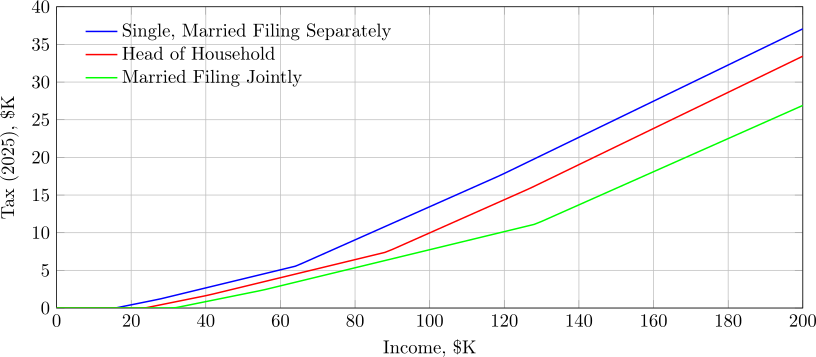
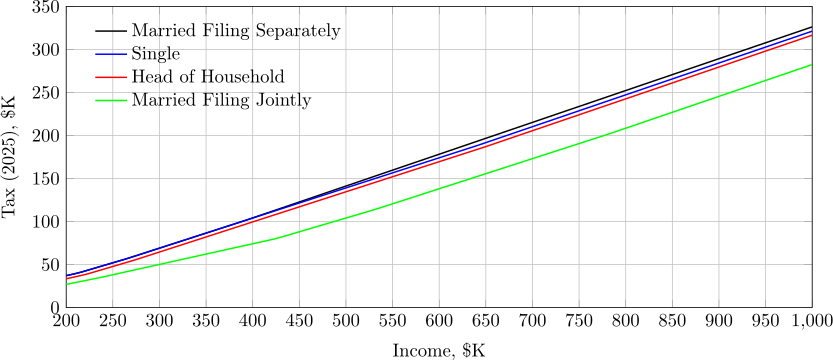
Figure 6.1 and Figure 6.2 illustrate how your tax filing status influences your standard deduction, tax brackets, and ultimately, your effective tax rate. Figure 6.1 highlights the effects on incomes below $200K, clearly showing the benefits of the standard deduction and higher tax brackets for those married filing jointly. Figure 6.2 focuses on incomes ranging from $200K to $1M, where the differences become less pronounced.